2025-08-13 · Dataset · Nature Communications 16, 7495
A dream EEG and mentation database (DREAM)
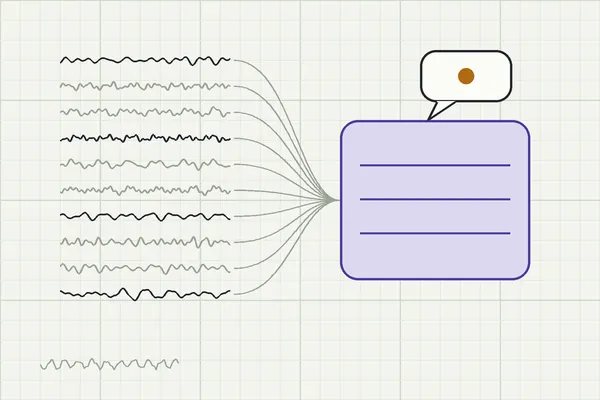
Twenty sleep studies pooled their brain recordings with what people said they were dreaming when woken up: 505 people, 2,643 awakenings.
When you wake someone in the night and ask what was going through their mind, sometimes they report a dream and sometimes nothing. Single labs could only collect a few hundred of these. This database pools them, so we can ask, with far more data, whether brain signals before waking predict a dream report.
Initial release: 20 datasets, 505 participants, 2,643 awakenings; each has sleep M/EEG (>= 20 s, >= 100 Hz, >= 2 electrodes) up to waking plus a standardised report class. Experience vs no experience decoded from EEG over 200 random train-test splits against a label-shuffled null: NREM best with spectral power features (mean AUC 0.586, 5th-95th percentile 0.505-0.608); REM best with catch22 features (mean AUC 0.700, 0.663-0.731). Six datasets used for these analyses. Registry open (doi:10.26180/22133105); dataset packages either open access or by request from the contributor. Main text does not say whether splits held out whole subjects.
What we do with it
The key resource for our dream vs no-dream test (task #6). Their AUCs are the bar to beat, but we split by subject and lab, so our numbers may come out lower. Planned
Read the original. Source checked against the original.